For many UK students, the journey to university begins long before they step onto campus. It starts on a smartphone screen. From the moment a student receives their UCAS confirmation, their social media algorithms shift, flooding their feeds with aesthetic “day in the life” vlogs, impeccably decorated dorm rooms, and snapshots of endless Freshers’ Week parties.
Platforms like TikTok, Instagram, and Pinterest have become the primary lens through which Sixth Form and College students view higher education. However, as the digital world becomes increasingly curated, a significant gap has emerged between the “Instagrammable” university experience and the actual reality of life at a UK institution.
In this comprehensive analysis, we explore how social media shapes the expectations of UK university life and provide actionable strategies for navigating the transition from digital fantasy to campus reality.
The Academic Reality: Transitioning from A-Levels to Independent Study
While social media focuses on the lifestyle, it often glosses over the rigorous academic transition. UK universities require a level of independent study that far exceeds the structured environment of secondary school.
The Expectation
Social media suggests academic success is about sitting in a cozy café with a matcha latte and a highlighter, effortlessly absorbing information.
The Reality
The reality involves complex referencing systems (like Harvard or OSCOLA), critical analysis, and the occasional struggle to meet a 3,000-word deadline. The jump from guided learning to self-directed research is the “hidden” challenge of the first year. This transition requires a shift in mindset—from being a “student” who follows a curriculum to a “scholar” who interrogates evidence.
For those struggling to bridge the gap between their expectations and the workload, seeking professional guidance is a common and proactive step. Whether it’s learning how to structure a dissertation or needing specialized chemistry assignment help at Myassignmenthelp.com to master complex molecular structures, academic support provides the tools necessary to turn the “stress” of university into “success.” Utilizing external expertise allows students to manage their time more effectively, ensuring they can meet university standards without sacrificing their mental well-being.
The “Aesthetic” Campus: The Rise of Studygram and University Vlogs
Social media has transformed the university experience into a visual commodity. The “Studygram” community and “StudyTube” influencers have created a specific, high-pressure aesthetic for academic life. This often involves:
- The Perfect Workspace: Minimalist desks, expensive stationery, and multiple 4K monitors.
- The Romanticized Library: Late-night sessions in Gothic-style libraries—like those at Oxford, Durham, or Glasgow—framed with soft lighting and lo-fi beats.
- The Hyper-Productive Student: Influencers who wake up at 5:00 AM, hit the gym, attend every lecture, and still have time for an elaborate social life.
For a student still finishing their A-Levels or BTECs, these images suggest that university is a time of constant productivity and effortless organization. While inspiring, it can create a false expectation: that if your life doesn’t look like a curated montage, you are failing. In reality, the most successful academic journeys are often messy, involving cluttered desks, late-night snacks, and hours of confusing research that doesn’t fit into a 15-second reel.
Freshers’ Week and the Psychology of FOMO
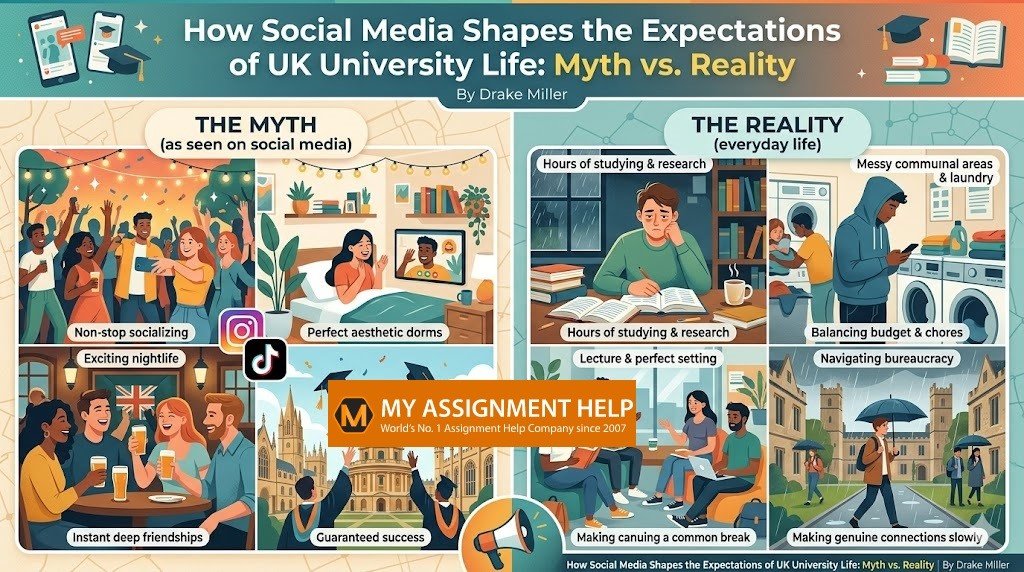
Perhaps the most significant impact of social media occurs during the first few weeks of the first year. Freshers’ Week is often portrayed as a non-stop carnival of making lifelong best friends and attending high-energy events.
When students see their peers posting “squad goals” photos within 48 hours of moving in, it triggers intense FOMO (Fear of Missing Out). What the photos don’t show are the moments of homesickness, the awkward small talk in the shared kitchen, and the fact that many of those “instant friendships” are often fleeting.
Social media creates a pressure to “peak” too early. Students often feel that if they haven’t found their “people” by the end of week one, they have failed the social aspect of university life. As a strategy for long-term success, students should understand that meaningful friendships in UK universities are formed over months through shared interests, academic societies, and course seminars—not just a tagged photo at a club.
The 2026 Shift: Agentic AI and the Modern Student Workflow
In the 2026 academic landscape, the “myth vs. reality” debate has a new player: Artificial Intelligence. Social media is currently flooded with “AI hacks” promising to write essays in seconds.
The Reality is that UK universities have integrated sophisticated AI detection and academic integrity frameworks. The modern “successful” student isn’t using AI to bypass learning, but rather adopting Agentic AI workflows—using LLMs as research partners for brainstorming structures, identifying gaps in literature, or explaining complex theories. Mastering the “human-in-the-loop” methodology is now a vital skill. Relying on shortcuts often leads to academic penalties, whereas students who choose to pay for assignments from dedicated academic services gain a better understanding of the how and why behind their work, ensuring they stay ahead of the curve.
The Financial Filter: The “Rich Student” Myth
Social media is notoriously bad at depicting financial struggle. UK students often see influencers going on “student trips” to Europe, wearing the latest fashion, and eating out at trendy city-center restaurants. This creates a skewed perception of the “student budget.”
The reality for the average UK student involves:
- The Maintenance Loan Gap: Managing a loan that often barely covers rent in cities like London, Manchester, or Bristol.
- The “Yellow Sticker” Hunt: Strategically shopping at Tesco, Aldi, or Lidl during markdown hours to make the budget stretch.
- Part-time Work: Balancing 15-20 hours of retail or hospitality work alongside a full-time degree.
The pressure to maintain a certain lifestyle for the sake of an Instagram feed can lead to significant financial anxiety. Understanding that the majority of students are in the same boat—prioritizing rent and groceries over “aesthetics”—is crucial for long-term mental health.
Mental Health and the “Highlight Reel” Effect
The most profound way social media shapes expectations is through the “Highlight Reel.” Students post their wins: the 2:1 grade, the society ball, the graduation photo. They rarely post about:
- The failed module or the feedback that bruised their ego.
- The loneliness of a rainy Tuesday in halls when everyone else seems to be out.
- The mental health struggles that affect roughly 1 in 4 students in the UK.
When a student’s internal reality (struggle) doesn’t match their external feed (perfection), it leads to a “belongingness deficit.” They feel like the only ones not having the “best time of their lives.” It is vital to remember that social media is a curated performance, not a documentary.
How to Navigate University Life in the Digital Age: A 2026 Toolkit
To ensure that social media enhances rather than ruins your university experience, consider these evidence-based strategies:
- Curate Your Feed with Intention: Follow accounts that show the “real” side of uni life—the messy rooms, the library stress, and the budget meals. Look for creators who discuss “student reality.”
- Practice Digital Minimalism: During high-stress periods, use tools like the Pomodoro Technique to separate focused study from digital distraction.
- Move Beyond the Screen: Real connections happen in university societies. These environments provide a sense of belonging that a “like” on a photo never can.
- Acknowledge the Learning Curve: It is okay to struggle with a complex seminar reading. University is a marathon of personal growth, not a sprint for social media engagement.
Frequently Asked Questions
Q.1 How can I manage the jump from A-Levels to University workloads?
The transition to university-level study is less about working harder and more about working smarter. While A-Levels are highly structured, university requires Active Recall and Spaced Repetition. Start by creating a “Second Brain” using tools like Notion or Obsidian to organize your research. If you find the referencing or structural requirements overwhelming, seeking professional academic assistance from experts like those at Myassignmenthelp.com can help you master the necessary academic standards early on.
Q.2 Is Freshers’ Week really the best time of university?
For some, yes; for many, no. While social media makes it look like the pinnacle of the student experience, it is often a high-pressure environment that doesn’t reflect the rest of the year. Most students find their genuine friend groups in the second term or even their second year through shared course interests and niche societies.
Q.3 How do I balance a social life with high academic expectations?
The key is Deep Work. Instead of spending eight hours in the library while distracted by your phone, commit to four hours of high-intensity, distraction-free study. This leaves you with guilt-free time for social activities. Remember, the “Studygram” influencers who seem to do it all are often filming their “productivity” rather than actually performing it.
Q.4 What should I do if my student loan doesn’t cover my living costs?
You are not alone. Over 70% of UK students now work part-time to supplement their maintenance loans. Focus on budgeting apps and local student discounts. Avoid trying to keep up with “influencer” lifestyles; real student life in the UK is built on community, shared meals, and finding joy in low-cost activities.
Q.5 Are academic help services legal in the UK?
Yes, using academic support services for guidance, tutoring, and as a model for your own research is a legitimate way to enhance your learning. We provide educational scaffolding that helps students understand complex assignment briefs and improve their own writing and analytical skills.
Conclusion: Embracing the Messy Reality
Social media has undoubtedly changed how we perceive UK university life. While it offers a platform for inspiration and connection, it also sets a dangerously high bar for “perfection.”
As you prepare for your journey into higher education, remember that the most valuable parts of university—intellectual discovery, personal resilience, and genuine friendship—rarely look perfect in a photograph. Embrace the challenges and the hard work required to earn your degree.
If the academic pressure starts to overshadow the experience, remember that help is always available. From university counseling services to specialized academic assistance at Myassignmenthelp.com, you don’t have to navigate this transition alone.
About the Author – Drake Miller
I am a skilled blog author associated with Myassignmenthelp.com, known for creating insightful and student-focused academic content. He specializes in topics related to assignment help, study strategies, and educational trends. With a clear writing style and practical approach, Drake helps students navigate academic challenges and improve their performance through well-researched, engaging, and informative articles.